Simon's Nairobi Diary - Archive 35
26 February 2007 7:47pm
We took her to the airport today. As she got her luggage and kids together, she was wearing towards tears from having to leave all of us. We didn't make it too harsh on her. A simple goodbye, and I watched as she focused her eyes on the security door and walked through. It was fast.
Driving back with Ndugu, he stopped for petrol, put a 200ksh in , and we began to drive away. "The needle is still on E," I pointed to him. He laughed and said, "Simon, you must learn! In Africa that E means Enough."
As this whole thing starts to diminish in its tear on me, I still hear how "it was his time". And I believe it, but I’m hard towards slogans in general, so I need to think it out a bit before I can trust it. Because this all just seems an impossibly mysterious thing to grasp for four small words to sum up.
I hesitate in not wanting to underscore the pain.
God is doing something good here, but I'm apprehensive towards writing off George’s death was a wonderful thing for the lives of her and her boys. Saying ‘It Was His Time’ and thinking all to be solved seems a bit insensitive to a twenty-something year old widow. I mean, the idea is well rooted in God being unfathomably bigger than we see, but I think this phrase-of-logic might beg people to seek an unattainable resolution the rest of their lives, and truth is many never find it. For many here, pain is a central part of this life that doesn’t send people looking for its reasons as much as for God’s reach.
In God's hands, the ugliness is part of a wonderful working, but from my view... well, it’s plain ugly, and I'm not going to pretend that during this lifetime some ultimate shining redemption will result from all this pain. I wish I was given His reasons for it, if I could even comprehend them with this brain, but God is the god and I am not, and I better not tear myself to pieces trying to see as one. So as long as I realize that the world turns in a messy way, I can say it was George’s time, since there works one who is molding beauty out of this messiness. Redemption is coming, and this tender scented concept bathes me in health and grace to live. Each night’s sleep is sweetly thickened by trust in God being bigger still, and so I have no panic about these coming days and years. Neither (amazingly, you should see it) does she and the boys. It’s because we see hints of an unfathomably beautiful tapestry, though only its distorted back, being woven from our lives.
22 February 2007 8:44pm
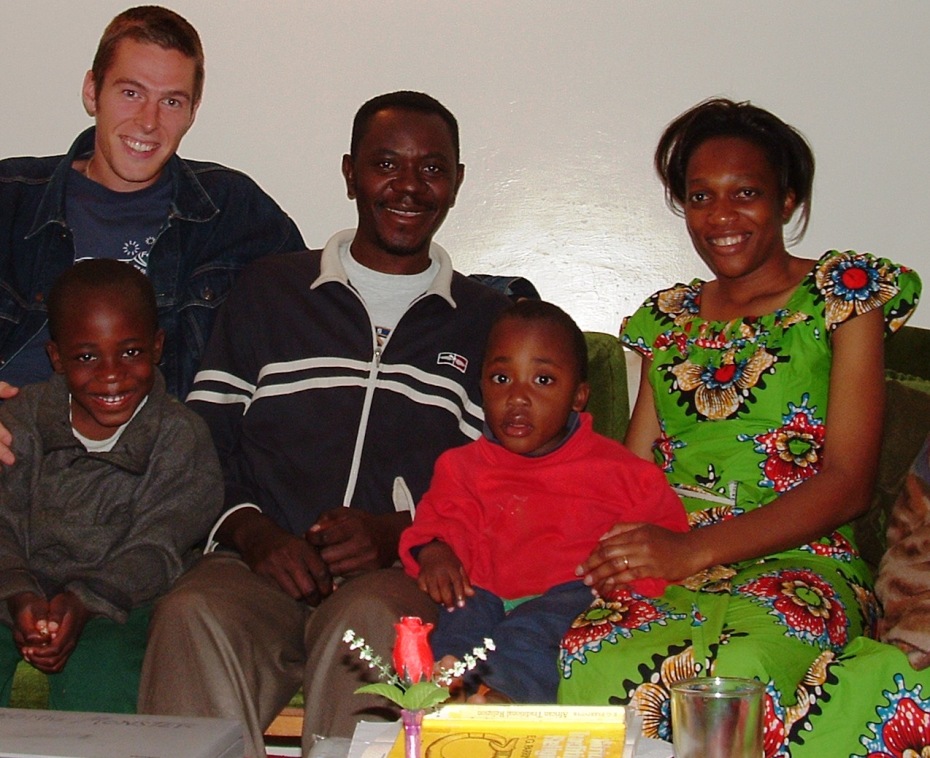
This was my friend George, his wonderful wife, and his two small boys ages six and three. He was from DR Congo, and came to NEGST the same time as myself, both of us reaching to be Masters of the DIVine by Jul2008. We were both the tall guys, gangly, standing in the back for the group photos. George was one of the few good friends I have found here, since my difference (cultural and other) makes solid friendships a tough thing to transpire. I think its because he grew up Catholic. We struggled together through heavy work loads and became friends because we could laugh together, which they tell me is the summit of cross cultural buddyness.
Two weeks to today I walked in his flat and found him dying. I didn't know this for sure, but felt it then. He had been mildly struggling against some mysterious ailment for three months, but nothing had prepared me for what I saw. It was simply the sickest person I've ever seen. I broke inside, and prayed for the first time in my life for mercy. I have never prayed for mercy, since it always seemed like telling God he was doing something wrong. But we prayed for mercy then and there, begging for his health, as his kids and wife stood nearby. I was so shaken.
We got him to the hospital and he was diagnosed with cancer, but died Saturday. We buried him today.
Listen to the students sing to sooth his death: here
There is his wife, broken and heavied, her family from Kinshasa at each arm to guide her to his grave. There are his boys, sometimes crying, sometimes playing, pensive. There are his friends, Tom, me, astonished with grief. We cover his coffin with this continent's red soil and lay a wreath of roses on top.
Angry too, at least I am. Not at God. At what has unfolded. A taste remains in my mouth, hasn't gone away, that this thing is not natural. A wonderful man, one of this schools precious deep thinkers, should not leave home for years of religious preparation, only to die at age 29 with just-diagnosed fully-metastasized cancer, leaving behind a widow and two small boys as aliens in a foreign land. This stuff just shouldn't be. It shouldn't. Its all so sour. It breaks my heart.
But I feel God's embrace around them, as He says over and over in the bible that he is the God of widows and orphans and aliens. He is their advocate and caretaker, and I look in their eyes (hers and theirs) and rest somehow in this new understanding. Then I feel God's patient anger hinted outside of this descended cloud of peace, soothing actually. Human beings just were not made to die, and when they do so it is pure ugly tragedy.
I turn then and see Jesus painted by scripture, placid and limp (like George today) in a musty grave three days since his death rattle. I see him simply inhale oxygen - and I SEE then the heavens and the earth and its teeming witnesses burst in wonder and choking gratitude. The heavy stone rolls languid to the right and he steps once into the sunrise and 'all that is His' lift their voices with relief solid as honey on the tongue. Not a relief from doubt but relief from being so inescapably wounded by simple human existence.
So I nurse this wound, and think its ok unhealed. It won't be for a while. Because if all this terrible 'falling to our knees' death is temporary, then that which overcomes it must be goodness enough to lift our legs from the ground.
16 February 2007 7:37pm
I don't think I have ever seen anything so staggering as the poverty here in Kenya. When we brought the 32 goats, 3500 lbs of maize/beans, 60 cooking pots, and 30 blankets to the village, it was a response to a community who lives in some of the greatest misery worldwide. And its easy to get swept away by the heartache. Everywhere and everything is saturated in how things should not be. Their environment, relationships, daily living, its all completely overwhelmed in brokenness, at least to my eyes. Their HIV is thriving like our acne. The diets of the children alone made me grieve. The prostitution-or-starvation scenario is normal. Attitudes, though I wish they were commonly resilient, are often quite hardened.
And I imagine it could be a way out to dismiss that a loving God exists. To say, "what a myth!" to our faith in a selfless passionate good God. In fact, this was my one fear about entering Africa to begin with, that I would be overwhelmed by the magnitude of how difficult things are here, and abandon my convenient Western notion of a God of Love.
But then I see in my mind's eye the time when I was broken and hopeless at age 20, having watched my ambitions turn to ash, and where the God of heaven and earth placed his hand into the tiny lump of my heart and revived me to loving life again. And I see that instance join the count of others before and after. I struggle but succeed to set those times alongside the terrible condition of the village. I remember that this good God does exist, just that the best is yet to come.
And I look at the people and their houses and their gut wrenching difficulties, and I cannot shake the feeling that its finishing, that the demon of its difficulty is struggling under the knife. By some mysterious notion, I feel a magnificent resolution is thundering towards Kipsongo, just over the nearby hilltops. God declares in Psalm 12:5, "Because the poor are distressed, because the needy groan, I will now rise up. I will place them in the safety they long for." I listen to the voice thats been ringing in my ears, and hear Him say, "I am coming soon!"
So, alongside a faith in the near-end of all this brokenness, I admit two other things. The first is to see that God moves because He has the heart and power to do something about it all, and since I have a similar power, I must embrace this ache to also move. Because the people of Kipsongo groan in their condition, I too will rise up and do everything I can to place them in the safety they long for. The second, though, is admitting that they know groaning more than I ever will, and as a result will find Him sweeter when they meet Him, being quicker to release the handlebars of themselves for life forever with Him. In this, I am impoverished.
6 February 2007 9:40pm
I wish, in the midst of the madness, at some five second span of the chaos, I wish I could have slowed what I saw. I would remove the sound completely. I would remove the people around the family, the grabbing hands, the open shouting faces. I would fade a bit the plastic torn huts, the garbage and sewage on the ground. I would crop the image to the tall father and mother, the small children, their new animal, the dazzled bunch of them, and I would slow to an afternoon the five seconds when they received their goat.
Seems like our motions met fertile ground and ran its vines to where the entire plot was seeded - sprouting with hope.
I would take that moment and stretch it and watch the father and mother and children have something for once, an action so very rare to their reality - having, I mean. Their minds spinning about where to go from this moment on. Because back then, before the goat, it was a mind that was geared on the frantic current moment, and now there was room in there for a week or more. That the face of the mother was one astonished and sinking in the fact that this week, and probably this month, that they were going to be alright.
They showed us that day, next to their five foot plastic garbage bag family hut, that there, right there, is where they were going to be keeping the goat, a space encircled with rolled thorn bush.
My father's secretary found out the price of a goat last month, and she came to his desk at work in Cadillac. "One goat please," she said, placing the cash on his desk. And he brought it here and moved it over to a bleating skippy milk goat - those listless pieces of green paper transformed into tranquility and raw continuance for a family in East Africa who have been eating garbage and sending their children to beg in the streets.
If I could, I would reduce the frame rate of those five seconds and take a time to sip slowly what I saw: a family starting to stand, a community's wounds turning a corner - stepping back from the brink of its throes, yes the world actually becoming a better place.
Might it really be true after all? Might we actually be the ones that we've been waiting for?
3 February 2007 10:36pm
My father, Rich, and myself rode bodabodas down to the Kipsongo slum from the town centre of Kitale. The bodaboda is a bike with a seat cushion on the back. The three of us when silently whizzing through the streets and down the hill towards Kipsongo. These bodaboda ridings would be the tranquil bookends to the village work.
By the time we had traveled throughout different places pulling maize, beans, cooking pots, and blankets into a lorry truck, the village had already gathered in the field nearby. The herd of goats were bounding around the area, legs and udders flapping, pushed around by the village elders clamoring to count. Counted like bills. Our guide George gathered the people and allowed each of us to say hello through his Kiturkana translation. Mostly we just said that though we had great differences we have the same heavenly father and are part of the same family.
Two elders stood up. The man said a fairly plain greeting and sat down, but the lady rose with shaking fists. I was afraid at first that she would be angry at us (a few were last time), but really she was overcome with gratitude for what we did. "Everyday our children have to go to the town to beg for food for our village, everyday we go to the garbage dump and search for something to eat or sell, and you have helped us," she said. Her anger, I realized, was directed at the squalor in which they lived, watching her children go everyday into town to beg for shilling coins.
Finally we packed all the goods (and goats) into the church building. George began to bring poor mothers to the church door, where they would get a goat and some maize/beans. Mother after mother came, many with seven or eight kids.
Then it all soured. I remember so well. Something sort of twisted in the air about it all, and suddenly I couldn't talk to Rich without raising my voice. A crowd had gathered at the church door, about two hundred at that point, and they became infuriated when they saw that 32 goats would not be even close to enough to go around. All of a sudden, the lucky mothers exiting the church left with their goats torn at by everybody around. The building itself became a dangerous place to be in. People outside, feeling the injustice, began to scream and shout and hit the church walls with sticks. Muscular men began to try to climb through the windows, and the ones which pushed through (despite our hands) landed on the floor and began to try and take things while we tried pushing them back out the door. Then people began to pull boards off the church. We realized we needed to get rid of these goats quickly, so we began to hurry. Outside my father watched as a family's goat was almost taken by a thug, if not for the wife of the family jumping on the thugs back and biting hard into his neck. Other families got all their kids to grab a goat leg, and they carried their precious bleating present to their garbage bag huts with all hooves off the ground.
By the time the pans and blankets were seen by the crowd, a mob had gathered, and the men through the window were coming faster.
We chose to evacuate. Our Swahili wasn't good enough to do anything anyways, and George had plenty of help. A muscle man named Jon pushed a path through the people for us, and we arrived out on the road, a languid humming bodaboda bicycle ride back to town, our eyes wide and spinning, our bodies full of sweat, our minds still reeling from the roar of their voices.
27 January 2007 5:39am
His testimony in chapel was similar to the others, not that it made it any less extraordinary. He described his conversion into a faith that made his life better, gave him hope, helped him to live and love and work in the right ways. His family did not see his Jesus all that highly. In fact, they told him if he wanted to live this way, it would not be as part of the family. They threw him out of the house, and for years he lived on the streets - praying for them. He had days at a time go by without food, without company, and years without his family. But he prayed for them still. "They hated me, but I did not hate them," he recounted. "I only know it was because they had not yet seen Jesus the way I had." And his voice grew tight and his eyes teared (despite it being unaccepted here) and he said with an impassioned whisper that "today I am so happy to say that they have all become saved", except his father, who died.
And then, again like so many of the others and no less wonderful, he raised his voice and sang a hymn acapella. It certainly wasn't the prettiest, but I have never ever in my life heard anybody sing "I surrender all" so truly. Ever. The ardor of it all filled the room like a cloud, and we were clothed (to the last of us) clothed in the love of our father in heaven.
That I would catch hold of what I live with here!
My father showed up tonight. I was sick yesterday, with a temp of 101, but Mom prayed for me and Thomas prayed over me and I feel like a million dollars. So we're going to Kitale to work with this village, to invigorate them, to be invigorated. We have a flat bed full of 32 milk goats to give them, over 1000 lbs of maize and beans, and extra to spare for child schooling fees and whatever other coming addendum, Thy kingdom come.
22 January 2007 9:44pm
The woman next to me, women next to me, were swathed in burkas and lighter skinned. One, she had her palms and finger tips died bright red with henna. The bus was taking us passengers 300 some km to near the Ugandan border, and for $7 no less, to Kitale - a quiet little town if one exists here. Near the town there is a mountain which is filled with salt, a place famous for its elephants who go there at night to dig and lick at the salt crust with their tusks. The bus was hitting the busted street (called tarmac here) like waves on a boat. Eventually the front left wheel began to make desperate pleas, like a sloshing silverware drawer. The driver was smoking out his window and told the ticketer over his shoulder to go outside with his lumpy metal tool, a tee shape with a pointed bottom and socketed side ends. The bus stopped and did a final metal sloshing heave into a road divet while the ticketer went outside with his tee to fiddle.
At once the aisle (if you call it that) was filled with hawkers of everykind. A man shoved a basketball (!) sized cabbage in my face. "Cah-badge?" I kept at my window. He walked away and was replaced by plums (veddy sweet!), then mammoth carrots, and then watches, ground nuts, passion fruit, and newspapers. The plums were 15 cents for a big bag. Finding the hankering unmet, I gave a 10ksh coin and got the bag. But then the rest saw I was in season and the offers rose to such a yammering that I feigned narcolepsy, mouth open temple against the window.
The ticketer wedged himself back in, the driver revved, and the hawkers vanished. My bench partner, in a red burka, sat loaded with veggies, peeling a passion fruit and sucking the seeds against her teeth. "Nice fruit huh," I said, breaching into our commonality. She looked terrified at me, showed the white parts of her eyes and pursed her mouth. "Veddy sweet," she said unblinking. "I'll let you know," I replied, biting a ruby plum. She ate only one but I ate the whole bag.