Simon's Nairobi Diary - Archive 25

23 May 2006 7:32pm

After the car had shouldered that rumpled road for five hours while the sand on either side and the scrub brush staying similar, the idea of what is 'rural' was redefined. The harshness in such a land continues from the wide to the tiny. The desert landscape and empty riverbeds wide, and the spines in the sand small. The first night we were in the rural north, on the edge of the Turkana village listening to the ornate singalong, my sandals became lined with sand burrs. A step down on the ground brought the feather light burr floating into the line between the foot and the sole. Floating thumb tacks. The next step squeezed it under the foot and into the skin. Stop, take off sandal, pluck out burrs, replace and walk lightly. I got it eventually.

While in the second of the three villages we visited the matriarch of the community. We were brought to her woven hut circled by spools of thorny brush. It keeps the goats in. She rose, bound in weathered skin and beadery. Her eyes were tired and intelligent. I greeted in Swa, trying hard not to be overcome by her bare midsection. A nearby child translated my greeting into Kiturkana. She nodded. A child on the right side tried to jump to grab my hand. She succeeded, but let go with wide eyes. Her hand drifted past the hem of her yellow dress to her bare heel and delicately dislodged an inch long thorn she had landed on from the matriarch's goat pen. When her eyes saw me watching she smiled through a blush. I wondered if she wanted to cry but had been taught never to do so. It is what they teach children here. My deepest instinct tells me this is wrong. But if I was a child living in a space of sand, thirst, thistles, burrs, thorns, hunger, raiders, and oppressive governments, I would be crying every day. Maybe they stopped the tears because nothing would ever get done.

It was harshness like a hard wind. It cannot be ignored, cannot be left behind. The world is a razor edge that is walked on and dealt with and the uncalloused get calloused or die early. The grip of the harsh life chases a person from birth to house to field to grave. This is how their world is. Smile through a blush. Don't cry.

22 May 2006 6:37pm

In Kitale, and other parts of Kenya, an interesting type of taxi service has been established. It is the boda-boda. The boda-boda is a bicycle with a thick cushion on the back end. After we finished distributing food, we had the rest of the day to get some much needed relaxation. First thing was to take a boda-boda tour of the city. It was difficult, at first, to arrange because I was asking for a "two-err". Finally they figured out I was asking for a "too-ah", and I hopped on the back of the bike. The boda-boda driver took me throughout the city and through the town's outskirts. It was an interesting ride. The biggest roundabout circles a fifteen foot coca-cola bottle. I held onto welded on handles and footpegs and was weaved through the thick crowds, who were vying for good prices on maize and fruit at the outdoor markets. The driver kept getting mocked by fellow boda-boda people he passed. I jokingly apologized for being a mzungu and he laughed. He brought me past the GigaMart (a Wal-Mart equivalent) and through the downtown area to arrive back with our group.

Kitale is the first town in Kenya I've felt comfortable in. There were almost no hawkers selling magazines and batteries. The pace of the town was so mild and the climate much warmer. Silent boda-boda bikes wandered languidly through the roads looking for work. On the sidewalk, men draped in measuring tape were using old Singer sewing machines to make clothes. The town was quiet and peaceful being distanced from the bustle/crowds/industry of Nairobi.

There was one break from the tranquility when we boarded the public bus back to Nairobi. As the driver was loading pair of chickens into the bottom of the vehicle, the twine wrapped around a chicken's legs got loose and the it went racing down the sidewalk. The driver and the chicken's owner cornered it and lunged but the chicken jumped away from them, screeching and pumping its neck. Eventually it was caught, rebound, and loaded into the bus belly. I was laughing till my sides hurt.

19 May 2006 8:12pm

I have a barf bag for a bookmark. My sister sent it to me as some sort of envelope. Now it is my partner in an expedition of the tome War & Peace. I am full of sickness and in bed, so it doubles in its duty, serving as a receptacle for any endoscopic debris expelled from between the upper and lower incisors. Barf. So the bag is much more than a bookmark, as it thricely carries a sentimentality of a sister.

I have a knack for such things, that is, ordinary things that are carriers of more. Especially clothes. This is aided by another knack of mine, that is, the knack of never never buying clothes (four years running). NWAirlines told me the suitcase could only weigh so and so, so the selection had to be careful and precise. Only the utmost meaningfulest clothes were brought. Like: the 1995 Harrietta 5K shirt my Dad and I ran in, the KCHS shirt from Sarah, the 2002 1stVD hoodie, Andrew's Australia tee he forgot about, Kyle's 2000 Taylor tee from the Hill, and three of Ethan's shirts. The Boomland hat.

I am homesick and shocked. Still, ugh, after all these months. But these reminders bring a piece of where I have been to where I am, giving precious continuity. Yes, with enough barf bag bookmarks one can live just about anywhere.

18 May 2006 7:19pm

At the last village we went to they would not let us take pictures. The village elders believed a person's picture caused their heart to burst. I was reminded of how many Native Americans felt the same thing. On the way back to Kitale we stopped near a village of very rural Turkanans to buy charcoal. They came to us and I was again struck by their beauty and majesty. The women wore their hair in a small strip down the center, with the rest shaved. They wore necklaces piled from their shoulders to their chins. All dressed with colored cloths draped across their bodies. Men carried the traditional Turkana small stool. It was the first time I have ever encountered a group of non-Western people. I asked, through our translator, if I could take their picture. They agreed, but I became hesitant.

Wordsworth is famous for his quote "we murder to dissect", and here I felt was presented an opportunity to do just that. I was nervous about capturing these pictures, because it would present these people without an experience. I can look at that picture of that beautiful Turkana woman and not see the village that she lives in or the way she became nervous about the attention. I can look at the men and not know how quiet they became as they were pictured. Something is robbed of a person, especially a non-Western, when a caricature is created out of them. Something gets left behind.

I took these pictures, but only after I promised myself that it was for showing people back home where the world is hurting, and where it is culturally rich. I understand better why God, in the Old Testament, was so insistent about people not making Him a temple or into an image.

17 May 2006 9:01pm

The ones who begged for water were the hardest to deal with. We had not really brought enough for ourselves, so when we arrived in Lokichung and they brought their dusty faces to the car, we could do nothing but watch. A woman the age of my mother began weeping outside my door. "Maji," she pleaded. "Maji." She began talking in swahili and clenching her hands. "Kuna maji?" Have water? We had none. I felt sorry for knowing Swahili. It was all stupid. I didn't know. I should have brought buckets. I should have ... I don't know, done something.

Instead, we drove onto the road and she was left in despair without the tears to express it.

I washed dishes today. I flushed a toilet and washed my hands. While taking a hot solar shower today, I just stared at the concrete floor while it poured through the drain. I do not feel guilt for the shower, but dischord. This is not how the world was meant to be.

16 May 2006 7:13pm

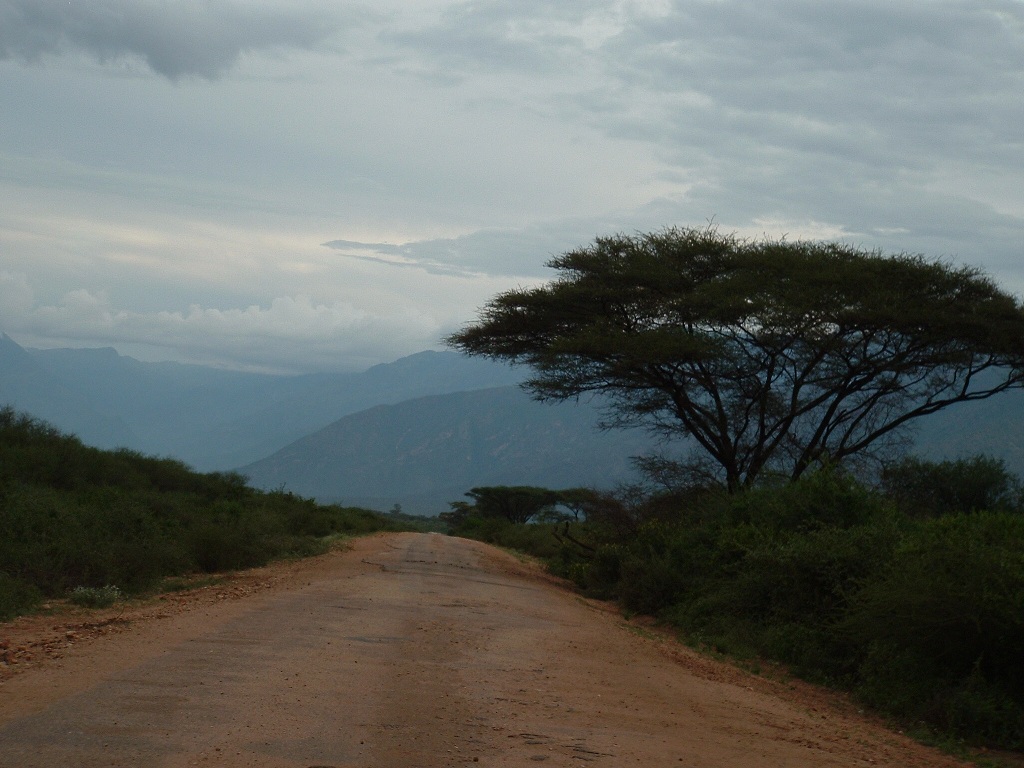
A book could be written about the stretch of road in between Kitale and Lodwar. It begins and immediately you are surrounded by lush green mountains and hills. The road is smooth and quick. Then the pavement begins to falter and bridges begin to not be there and offroad detours become common. The police checks become fewer and the mountains end and all of a sudden the car is in the desert. I remember looking back at the mountains and looking forward again at the sand because the switch was so dramatic. The pavement only existed in islands then, and the car slowed down to 25mph for the remaining five hours.

We were supposed to have a police escort through the dangerous section of the journey, but the one guard they gave us was wearing a dirty flannel shirt & Royals cap. He wanted ridiculous amounts of cash. He carried the massive green M15 on his hip and swaggared towards our car. "Do you have a uniform or something? Something to deter people?" "Have you heard of undercover," he sweated back? Undercover Kenyan police with a machine gun seemed to only promote violence, not hinder robbery. Our guide told us that he thought the road was safe, so we went without the gun.

The desert is so beautiful. Massive skies, sporatic brush, and 20ft tubish termite mounds. All that travel in the desert, and we passed barely any cars. Pretty much just a petroleum tanker, a CocaCola truck, and NGO jeeps. I could not believe all the dried river beds we crossed, created by the lack of any rain for the past 7 months. I was amazed by the isolated villages. Just sand for an hour and then, in the distance, a small circle of woven grass huts and a herd of goats.

We arrived in Lodwar at dark. I was going to brush my teeth but stopped because of a sound. It was drums and voices. Walking towards it, I stood outside a circle of palm-leaf huts and witnessed a Turkana village spending their Friday night around a glowing fire, beating a drum and singing.

Large update in 'Pictures' to the left. Enjoy.

15 May 2006 8:24pm

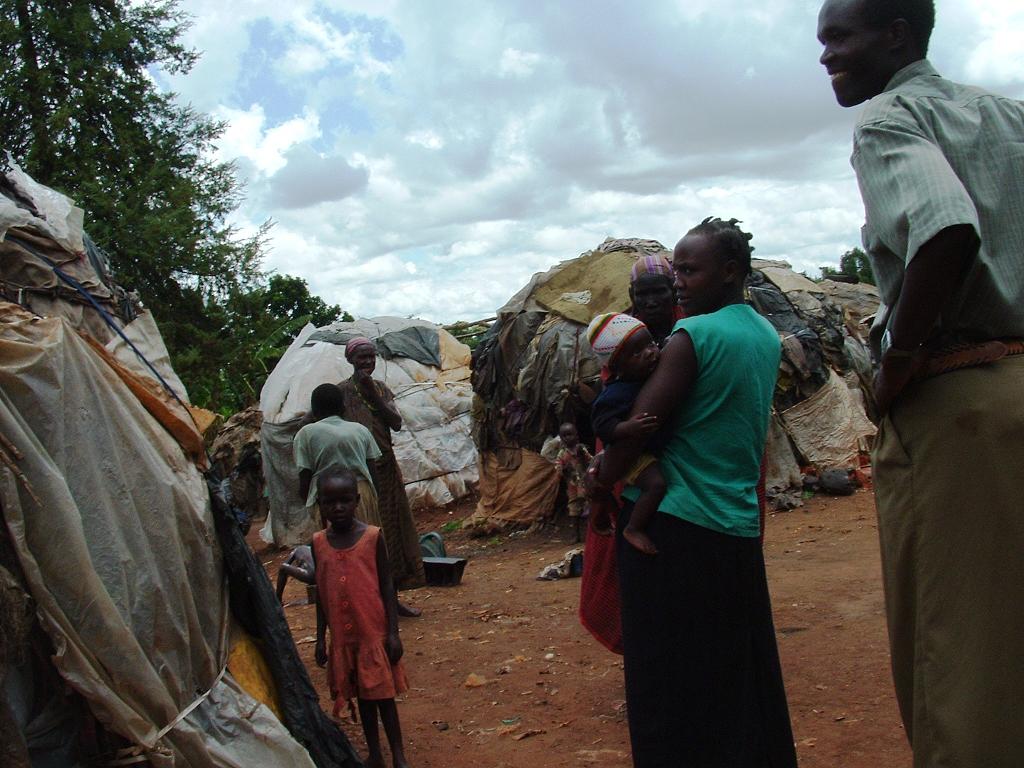
Last weekend was, in estimation, the most changing weekend of my life. The village we went to, Kipsongo, is a village of Turkana people who came as refugees about 30 years ago. They are very poor. We entered the village and I became so saddened. The children, malnourished and ragged, surrounded us and grabbed our fingers. One sucked on a blackened mango pit. My whole life they have been statistics, and then they became faces and hands. They became men with missing limbs and brain damage, women nursing undergrown children with empty breasts. Many little boys ran with their faces covered in scum, flies packed in their eye sockets, lips, and nostrils. One jumped over a ditch to greet us. He was so excited. The flies bounced off his face and perfectly relanded. It was all bones and eyes there. I realized something was out of place, found it to be the mint gum I was chewing. I swallowed. We did our best to love, reciprocate selflessness, and show them hope though we were overcome by it all.

We brought 1100 pounds of beans and maize into the local church. The pastor had logged the needs on a list titled, "Hungry Families in Kipsongo". These families and their suffering filled the church benches and patiently waited to fill bags with food, first greeting us by taking our hand and placing it on their forehead. The pastor asked me if I could say a word. A word? I was terrified because I saw their delicacy. "Are you here?" I asked God quietly. His spirit soared in reply. "Breathe through Father." I stood and looked at their haggard faces and said the only thing that came to mind. Through a kiturkana translator I said that we did not come as superiors but as equals, as their brothers and sisters, and we had food for them. I told them that the bags of food would soon be empty, and also their stomachs, but God's love for them will always keep them filled, even if they starve. They smiled and raised their hands in praise and I subsequently fully believed what had been spoken.

   

Karibu kila mtu.

 LOVINGLY
 ENROLLED AT:

Music Download:
Harrietta

Support this Site:

Blogs of goodness:

Adrienne
Alli
Amber
Amy
Ashley
Ben
Carly
Chad
Daylan
Emma Pamela
Grant
Jeff&Mark
Joseph
Katie
Katrina
Kay&Dave
Kayla
Kent
Krista
Mary
Megan
Phil
Scholar
Sean
Shane

   
Archive 25

           23 May 2006 7:32pm                                                   

After the car had shouldered that rumpled road for five hours while the sand on either side and the scrub brush staying similar, the idea of what is 'rural' was redefined. The harshness in such a land continues from the wide to the tiny. The desert landscape and empty riverbeds wide, and the spines in the sand small. The first night we were in the rural north, on the edge of the Turkana village listening to the ornate singalong, my sandals became lined with sand burrs. A step down on the ground brought the feather light burr floating into the line between the foot and the sole. Floating thumb tacks. The next step squeezed it under the foot and into the skin. Stop, take off sandal, pluck out burrs, replace and walk lightly. I got it eventually.

While in the second of the three villages we visited the matriarch of the community. We were brought to her woven hut circled by spools of thorny brush. It keeps the goats in. She rose, bound in weathered skin and beadery. Her eyes were tired and intelligent. I greeted in Swa, trying hard not to be overcome by her bare midsection. A nearby child translated my greeting into Kiturkana. She nodded. A child on the right side tried to jump to grab my hand. She succeeded, but let go with wide eyes. Her hand drifted past the hem of her yellow dress to her bare heel and delicately dislodged an inch long thorn she had landed on from the matriarch's goat pen. When her eyes saw me watching she smiled through a blush. I wondered if she wanted to cry but had been taught never to do so. It is what they teach children here. My deepest instinct tells me this is wrong. But if I was a child living in a space of sand, thirst, thistles, burrs, thorns, hunger, raiders, and oppressive governments, I would be crying every day. Maybe they stopped the tears because nothing would ever get done.

It was harshness like a hard wind. It cannot be ignored, cannot be left behind. The world is a razor edge that is walked on and dealt with and the uncalloused get calloused or die early. The grip of the harsh life chases a person from birth to house to field to grave. This is how their world is. Smile through a blush. Don't cry.

           22 May 2006 6:37pm                                                   

In Kitale, and other parts of Kenya, an interesting type of taxi service has been established. It is the boda-boda. The boda-boda is a bicycle with a thick cushion on the back end. After we finished distributing food, we had the rest of the day to get some much needed relaxation. First thing was to take a boda-boda tour of the city. It was difficult, at first, to arrange because I was asking for a "two-err". Finally they figured out I was asking for a "too-ah", and I hopped on the back of the bike. The boda-boda driver took me throughout the city and through the town's outskirts. It was an interesting ride. The biggest roundabout circles a fifteen foot coca-cola bottle. I held onto welded on handles and footpegs and was weaved through the thick crowds, who were vying for good prices on maize and fruit at the outdoor markets. The driver kept getting mocked by fellow boda-boda people he passed. I jokingly apologized for being a mzungu and he laughed. He brought me past the GigaMart (a Wal-Mart equivalent) and through the downtown area to arrive back with our group.

Kitale is the first town in Kenya I've felt comfortable in. There were almost no hawkers selling magazines and batteries. The pace of the town was so mild and the climate much warmer. Silent boda-boda bikes wandered languidly through the roads looking for work. On the sidewalk, men draped in measuring tape were using old Singer sewing machines to make clothes. The town was quiet and peaceful being distanced from the bustle/crowds/industry of Nairobi.

There was one break from the tranquility when we boarded the public bus back to Nairobi. As the driver was loading pair of chickens into the bottom of the vehicle, the twine wrapped around a chicken's legs got loose and the it went racing down the sidewalk. The driver and the chicken's owner cornered it and lunged but the chicken jumped away from them, screeching and pumping its neck. Eventually it was caught, rebound, and loaded into the bus belly. I was laughing till my sides hurt.

           19 May 2006 8:12pm                                                   

I have a barf bag for a bookmark. My sister sent it to me as some sort of envelope. Now it is my partner in an expedition of the tome War & Peace. I am full of sickness and in bed, so it doubles in its duty, serving as a receptacle for any endoscopic debris expelled from between the upper and lower incisors. Barf. So the bag is much more than a bookmark, as it thricely carries a sentimentality of a sister.

I have a knack for such things, that is, ordinary things that are carriers of more. Especially clothes. This is aided by another knack of mine, that is, the knack of never never buying clothes (four years running). NWAirlines told me the suitcase could only weigh so and so, so the selection had to be careful and precise. Only the utmost meaningfulest clothes were brought. Like: the 1995 Harrietta 5K shirt my Dad and I ran in, the KCHS shirt from Sarah, the 2002 1stVD hoodie, Andrew's Australia tee he forgot about, Kyle's 2000 Taylor tee from the Hill, and three of Ethan's shirts. The Boomland hat.

I am homesick and shocked. Still, ugh, after all these months. But these reminders bring a piece of where I have been to where I am, giving precious continuity. Yes, with enough barf bag bookmarks one can live just about anywhere.

           18 May 2006 7:19pm                                                   

At the last village we went to they would not let us take pictures. The village elders believed a person's picture caused their heart to burst. I was reminded of how many Native Americans felt the same thing. On the way back to Kitale we stopped near a village of very rural Turkanans to buy charcoal. They came to us and I was again struck by their beauty and majesty. The women wore their hair in a small strip down the center, with the rest shaved. They wore necklaces piled from their shoulders to their chins. All dressed with colored cloths draped across their bodies. Men carried the traditional Turkana small stool. It was the first time I have ever encountered a group of non-Western people. I asked, through our translator, if I could take their picture. They agreed, but I became hesitant.

Wordsworth is famous for his quote "we murder to dissect", and here I felt was presented an opportunity to do just that. I was nervous about capturing these pictures, because it would present these people without an experience. I can look at that picture of that beautiful Turkana woman and not see the village that she lives in or the way she became nervous about the attention. I can look at the men and not know how quiet they became as they were pictured. Something is robbed of a person, especially a non-Western, when a caricature is created out of them. Something gets left behind.

I took these pictures, but only after I promised myself that it was for showing people back home where the world is hurting, and where it is culturally rich. I understand better why God, in the Old Testament, was so insistent about people not making Him a temple or into an image.

           17 May 2006 9:01pm                                                   

The ones who begged for water were the hardest to deal with. We had not really brought enough for ourselves, so when we arrived in Lokichung and they brought their dusty faces to the car, we could do nothing but watch. A woman the age of my mother began weeping outside my door. "Maji," she pleaded. "Maji." She began talking in swahili and clenching her hands. "Kuna maji?" Have water? We had none. I felt sorry for knowing Swahili. It was all stupid. I didn't know. I should have brought buckets. I should have ... I don't know, done something.

Instead, we drove onto the road and she was left in despair without the tears to express it.

I washed dishes today. I flushed a toilet and washed my hands. While taking a hot solar shower today, I just stared at the concrete floor while it poured through the drain. I do not feel guilt for the shower, but dischord. This is not how the world was meant to be.

           16 May 2006 7:13pm                                                   

A book could be written about the stretch of road in between Kitale and Lodwar. It begins and immediately you are surrounded by lush green mountains and hills. The road is smooth and quick. Then the pavement begins to falter and bridges begin to not be there and offroad detours become common. The police checks become fewer and the mountains end and all of a sudden the car is in the desert. I remember looking back at the mountains and looking forward again at the sand because the switch was so dramatic. The pavement only existed in islands then, and the car slowed down to 25mph for the remaining five hours.

We were supposed to have a police escort through the dangerous section of the journey, but the one guard they gave us was wearing a dirty flannel shirt & Royals cap. He wanted ridiculous amounts of cash. He carried the massive green M15 on his hip and swaggared towards our car. "Do you have a uniform or something? Something to deter people?" "Have you heard of undercover," he sweated back? Undercover Kenyan police with a machine gun seemed to only promote violence, not hinder robbery. Our guide told us that he thought the road was safe, so we went without the gun.

The desert is so beautiful. Massive skies, sporatic brush, and 20ft tubish termite mounds. All that travel in the desert, and we passed barely any cars. Pretty much just a petroleum tanker, a CocaCola truck, and NGO jeeps. I could not believe all the dried river beds we crossed, created by the lack of any rain for the past 7 months. I was amazed by the isolated villages. Just sand for an hour and then, in the distance, a small circle of woven grass huts and a herd of goats.

We arrived in Lodwar at dark. I was going to brush my teeth but stopped because of a sound. It was drums and voices. Walking towards it, I stood outside a circle of palm-leaf huts and witnessed a Turkana village spending their Friday night around a glowing fire, beating a drum and singing.

Large update in 'Pictures' to the left. Enjoy.

           15 May 2006 8:24pm                                                   

Last weekend was, in estimation, the most changing weekend of my life. The village we went to, Kipsongo, is a village of Turkana people who came as refugees about 30 years ago. They are very poor. We entered the village and I became so saddened. The children, malnourished and ragged, surrounded us and grabbed our fingers. One sucked on a blackened mango pit. My whole life they have been statistics, and then they became faces and hands. They became men with missing limbs and brain damage, women nursing undergrown children with empty breasts. Many little boys ran with their faces covered in scum, flies packed in their eye sockets, lips, and nostrils. One jumped over a ditch to greet us. He was so excited. The flies bounced off his face and perfectly relanded. It was all bones and eyes there. I realized something was out of place, found it to be the mint gum I was chewing. I swallowed. We did our best to love, reciprocate selflessness, and show them hope though we were overcome by it all.

We brought 1100 pounds of beans and maize into the local church. The pastor had logged the needs on a list titled, "Hungry Families in Kipsongo". These families and their suffering filled the church benches and patiently waited to fill bags with food, first greeting us by taking our hand and placing it on their forehead. The pastor asked me if I could say a word. A word? I was terrified because I saw their delicacy. "Are you here?" I asked God quietly. His spirit soared in reply. "Breathe through Father." I stood and looked at their haggard faces and said the only thing that came to mind. Through a kiturkana translator I said that we did not come as superiors but as equals, as their brothers and sisters, and we had food for them. I told them that the bags of food would soon be empty, and also their stomachs, but God's love for them will always keep them filled, even if they starve. They smiled and raised their hands in praise and I subsequently fully believed what had been spoken.



Year 5
- Archive 58 Archive 57 -           

Year 4
- Archive 56 55 54 53 52 Archive 51 -           

Year 3
- Archive 50 49 48 47 46 45 44 43 42 41 Archive 40 -           

Year 2
- Archive 39 38 37 36 35 34 33 32 31 Archive 30 -           

Year 1
- Archive 29 28 27 26 25 24 23 22 21 Archive 20 -
- Archive 19 18 17 16 15 14 13 12 11 Archive 10 -
- Archive 9 8 7 6 5 4 3 2 Archive 1 -